post

2024: A Big Year for Will & Janet

Putting politics aside, 2024 was a momentous year for both of us. We started the year staying at our place on the Big Island of Hawaii as we’ve done for the past three years. Work starts for me long before sunrise. Janet stays on a less early but still busy schedule. We entertained ourselves with visits from friends and family, bike rides, scuba diving, and amazing sunsets nearly every day. We ended the year in Hawaii as well, with me partially recovering from surgery for a partial retinal detachment from which I’m now recovering from a second less invasive surgery the second week of January, and for which I’ve included a public service announcement at the end of this blog. If you’re particularly nearsighted, please be sure to read it.

I’m 25% Swedish but had never been to Sweden even for business. Our good friend Janet M. is 50% Swedish and was in the same situation. In June, the two Janets, Janet M’s husband Tim, and I went to Copenhagen and then drove across Sweden. We visited our ancestral homelands where we enjoyed both the countryside and Stockholm, and completed our trip in Kiruna, the Northern-most inhabited Swedish city, inside the Artic Circle.

In October, we joined friends in Kolkata (formerly Calcutta) India for about a week to experience an annual event called Durga Puja, during which the goddess Durga’s victory over evil is celebrated. Even our Indian friends pointed out “…it’s really crowded…”, which says something. Millions attend, similar but likely larger to the numbers for Carnival in Rio. The crowds were not as bad as we were warned, and it was visually stunning along with great cultural immersion, learning, and wonderful Bengali food. More here.

Fulfilling Work for Both of Us

While we did have two nice vacations this year, Janet and I both worked as hard as ever, enjoying most of it as usual. Janet finished her time on the Seattle Foundation board, ramped up her engagement with the Womens Donor Network, and helped the reproductive rights nonprofit she co-founded get into high gear. All of the younger generation are doing well, with William still using big data and AI to help find the fountain of youth at Altos Labs, Sarah with a thriving therapy practice as well as a thriving new office concept for therapists, The Reflective Collective, and Aabha happily working to bring healthcare and AI together at Commure.

I remain focused on venture capital investing in India and the Global South, with a team distributed around the world. There are now only four of us in USA, five spread from Mexico City to Sao Paulo, two in Nairobi, fifteen in Bangalore, and two in Jakarta. We had two big milestones this year – one very profitable sale of a gig enablement company in India, and a second similarly profitable partial sale of our stake in a payments company (that’s now a unicorn!) addressing the under-banked in Nigeria. It helps grow one’s VC business when you start chasing your investors to get their bank info to send them money. With three other companies preparing for IPOs in 2025, the year ahead will not be boring; planning and capacity building is the name of the game. I’ve also been writing quite a bit about VC and Generative AI in the Global South, with some interesting posts here and others here. And I am almost through the first draft of a book I’m co-authoring, titled “Flourishing with AI“. I’m always looking for interesting people to interview for the book – please send anyone my way you think would be interesting (target age 27 to 40).

A Public Service Announcement: Take Care of Your Eyes

As alluded to above, I ended the year with a narrow miss in losing vision in my right eye, and as of week 1 January, I’m still not out of the woods, with a second less invasive surgical recovery in the process. I’ve known I’m at risk of retinal issues as they run in my family (my dad had a detachment when he was 30, and his mother and grandmother had issues as well). I’ve been religious about getting annual exams and watching for anything remotely out of the ordinary. To make a long story short, I had my third posterior vitreous detachment (“PVD”) in late October, which led to a partial retinal detachment likely at the same time, but not diagnosed by two different specialists until I saw a third the Tuesday before Thanksgiving (Nov 26th). The detachment was not caused by my mountain biking or anything I did other than being fathered by someone with similar issues that he inherited as well. Genetics are what they are; being acutely aware is usually all you can do. This is how I spent a week post-surgery, lying on my side or face down, 24×7, other than a few breaks a day. And how I’m doing it again after surgery #2. Ugh.

If you are very nearsighted (which you can determine by a negative number in your distance vision correction in your glasses or contacts being between -3.5 to -6) or extremely nearsighted (greater than -6), and/or you have a family history of retinal issues, please pay attention. Being over 50 is another contributing factor. If you’re farsighted or average nearsigned and have no family history, this situation is not likely to be a problem for you.

PVDs as the Beginning: PVDs are quite common in people over 50 who are modestly nearsighted. In their simplest form, they create a floater or two and nothing else. But they can be indicative of a potential for a future retinal tear, which is why you should learn the symptoms of a PVD, how to distinguish between a floater and a sign of a retinal tear, and to in all cases ensure you see a good retinal doctor as immediately as possible if you notice a PVD.

Your Eyes and Detachments

Vitreous Humor: This is a gel-like substance that fills the eye, primarily composed of water and collagen. At birth, it has a gel state due to a network of fine collagen fibrils. With age, the collagen fibrils aggregate and the vitreous becomes more liquid, leading to a condition known as vitreous liquefaction. This process typically begins around age four and continues throughout life.

Vitreous Detachment: As the vitreous shrinks and liquefies, it may pull away from the retina, a phenomenon referred to as posterior vitreous detachment (PVD). This usually occurs after age 50, with increased risk as one ages. During PVD, the vitreous can exert tearing pressure on the retina due to its attachment at certain points. This can lead to complications such as retinal tears or detachment.

Symptoms: Common symptoms of vitreous detachment include an increase in floaters (small dark spots in vision) and flashes of light in your peripheral vision. These occur when strands of the vitreous cast shadows on the retina and/or tug on it. You need to get them checked, but chances are you are OK. The things to be really focused on are symptoms of retinal detachment. They include bright flashes of light, especially in peripheral vision, blurred vision, new floaters in the eye that appear suddenly, and/or what happened in my case, shadowing or decreased peripheral vision that seems like a curtain or shade across your vision. The latter is a big deal – don’t let anyone try to convince you that it’s “just a big floater” which is what happened to me.

Treatment Speed: Time is of the essence once your retina starts to tear or detach.

I know two people who had partial detachments and were not able to able to treat them as quickly as they should have. One has regained full vision, the other never will. Fortunately, I noticed the symptoms, went to specialists three times, and during the third visit, Doctor Eugene Ng (to whom I’m most grateful) said “uh-oh”. This is not something you want to hear. We did the ultrasound and saw it was clearly torn. The two lines at the bottom of this ultrasound image are my retina pulling off the back of my eye. I went for emergency surgery later that day. That entailed flying from the Big Island of Hawaii to Oahu which is about a 30 minute flight away, where they have a hospital with appropriate specialized equipment and trained nurses to support the surgeon. We came back the next day and I then spent the following week working from my phone lying face down and/or lying on my side looking at the palm trees and listening to podcasts. Thankfully I had Janet and other family members around to help out. And then 4 weeks later, going in for a routine post-op checkup, we found some anomalies, went to a specialist who did the deep imaging, and found that I have yet another partial detachment in evidence. Hence surgery #2 which is a little different and hopefully will be a once-and-for-all fix. Dr. Eng used a series of laser zaps. Imagine looking into a bright light and the doc looking through a special lens to see the places to fix and he pulls the trigger and a laser cooks a little bit of your eye to make the scar tissue hold it all together. I’ve done this twice now, which hopefully is all that’s needed. I will not know that for another month or two, but everyone is fairly confident that this will work.

Summary

When I had my first PVD 2.5 years ago, it freaked me out and I went to see a specialist immediately. They confirmed it was not a problem, and they said I was likely to have one in the other eye within a year. That indeed happened about a year later, and I took it in stride, going to see a specialist a few weeks after, as I was a bit of an expert at that point. It was the third time, about 9 months later, that the symptoms were different. Thankfully I jumped on it and monitored closely, ultimately getting surgeries not too long after the tears kicked in, and I’m confident I’ll have a full recovery. Recommendation to my readers: if you have any of the correlated risks noted above, dive in and learn more, do not doubt yourself when you see things that do not seem right, don’t take chances, and be prepared to do whatever it takes to get it fixed quickly if this happens to you.

Will

post

Thoughts About Africa

I had never been to sub Saharan Africa before. We went to a private game reserve in South Africa called MalaMala. Then we went with some friends to Zambia near Kafue National Park. We stayed a couple days in Livingstone to see Victoria Falls. And we spent one day in Johannesburg where we visited an Afrikaner Village near Pretoria and a new high school.

Keep reading — I mix up thoughts and photos…

The Animals at MalaMala

What can I say? The animals were amazing. MalaMala was teeming with them. We arrived at noon and that first afternoon we went on Safari and saw a cheetah. During the course of our four days, we saw lions and leopards, rhinos and warthogs, giraffes and zebras, cape buffalo and wild dogs, hyenas and vultures, baboons, antelope of all kinds – kudu and impala and more, and birds. I don’t even like birds but marveled at the many beautiful ones we saw. We saw four different kills at MalaMala – not as they were happening but shortly afterward. The best for me was a mother leopard who had caught a kudu, carried it up a tree and then brought her cub up. The cub played with the kudu on one branch while the mother watched from a higher branch.  We also watched (heard) a male lion who was only a few feet away roar. The ground truly shook. Watching the lions was like watching my cats at home – the way they licked their paws to clean their faces or rolled over after a good meal.

The Scene at MalaMala

MalaMala is a beautiful resort with a hundred or so rooms spread through three different areas owned by the Rattray family. It is all inclusive with good food, well-trained rangers, and a nice pool. But most of all lots of animals. It is contiguous to Kruger National Park and the animals roam freely between the two.

When you get there, you are assigned a ranger and a Landrover. No more than six people are in a Landrover. We go out early each morning around sunrise and return for breakfast. Then there is free time to swim or sleep or read. We go out again around 4 pm and stay until dark with the rangers using spot lights to see animals at night. We saw lots of beautiful sunrises, sunsets, and moon rises.

For most of our stay, we were with only two other guests in our Landrover — a wonderful older woman named Pam and her niece Victoria from Britain. Pam – and previously her husband – have been coming to MalaMala every year for 30 years and she has become friends with the owners. Victoria had accompanied her before. They knew the genealogy of many of the animals. And Victoria was the best at spotting animals and following animal tracks in the sand.

Because Pam knew the owners we were lucky to have Mike and Norma (and one day their daughter Alison) join us at dinner. I thought they were delightful and gracious and we learned a lot about the game reserve and South Africa from them. Will and I were reminded of his grandparents. Mike’s father bought the land originally but Mike himself was quite a visionary, changing from a hunting reserve to a photo only reserve in the 60s. Mike and Norma told us about problems with poaching as well as how the government is buying back their land (at a fair price) to give to Africans from which it was taken long ago. They were worried about this as many Africans don’t have the business experience to run a resort. However, they said that they would be leasing the land back and running the resort for a time.

The rangers are all twenty-something youth who are well trained about the plants and animals, animal tracks, shooting, and driving Landrovers off road. They have radios and share information about what they see. Hearing of a kill or a leopard sighting, they are off across country, over trees and river beds. It is very dramatic and quite fun.  MalaMala is strict about no more than three vehicles near any animal so the rangers take turns. Our ranger, Matt, was a nice young man, very knowledgeable. He told us that after doing this for a few years, he wanted to return to school and work in finance. Will asked him how he would transition from being outside in the wild all the time to a desk job. He said it would be hard but he thought it would be best for financial security.

Kafue River Camp

We flew from MalaMala to Livingstone Zambia where we spent the night and then met up with friends – Paul, Yaffa, Dan, and Caroline — for the second half of the trip. Our friend Paul, who grew up in Rhodesia and South Africa, owns some land along the Kafue River near Kafue National Park. Paul and Yaffa are friends from the Seattle area. Dan and Caroline are from LA. He is an expert on child development and neurobiology. Caroline was a litigation attorney but now works with Dan. Their kids are almost exactly the same age as ours and we soon realized we have much in common and much to talk about.

To get to KRC, you take a small chartered plan for about 75 minutes, land on an unpaved airstrip, get into a Land Cruiser, and drive another 90 minutes. As we drove, we were attacked by tsetse flies and I was worried that the stay would be terrible. But there are no flies at the camp – only beautiful solitude, a picturesque river, animals, good food, fine friends, and lazy days – completely off line.  No people except for us and the staff. No noise except the animals – especially the hippos and lions.

View from camp

View from camp

Our cabin

Our cabin

KRC has four rooms – concrete slabs with thick canvas walls and roof and thatch over all. At the back, enclosed by concrete but open to the sky is a toilet, sink, and shower – all with river water heated by a coal stove which the staff lights morning and evening. Food is cooked in a pizza oven and served in a separate eating and sitting area overlooking the river.

Our hot water heater

Our hot water heater

Dining Area

Dining Area

The staff consists of Austen – a former game hunter who has lots of great stories – and some men from the local village who lead us on game drives, cook and clean.

Depending on the day, we go for game drives in the Land Cruiser or on mountain bikes. We wade in the river to an island across the way, walking around the island and “swimming” in the 8 – 10 inches of water just nearby. One day, Yaffa, Caroline, Dan and I go for a little run to get some exercise. Another day Yaffa and I walk fast while the others mountain bike again. A staff member accompanies us. During one of our drives, we are watching the puku – a kind of antelope – prancing along when all of a sudden one seems to jump much higher. Only it’s not a puku but a lioness making a kill. It was thrilling to see. The lioness held on to the puku until it died and then she dragged it across the field to a thicket to eat.

Jifumpa Village

The nearest village to KRC is Jifumpa, about 90 minutes away and we go off one day. We cross the river on a pontoon.

Pontoon crossing

Pontoon crossing

Clinic maternity ward

Clinic maternity ward

The village is about 1000 people with 4000 in the nearby area. There is a school and a clinic. Paul and Yaffa have given money to build a house for a teacher and to build a bore hole for a new well.

The trip to the village was a highlight for me because it opened my eyes to the challenges of Africa. I had been reading a book called The Fate of Africa by Martin Meredith which follows African history since Independence. The book is depressing as it describes endemic corruption, wars, famine, indifferent cruelty. The book also explained that nearly a trillion dollars of western aid has been given to Africa, a huge amount pocketed by corrupt leaders, and very little to show for it. I hoped that a trip to a village would change my thinking.

The good news is that the children we met were eager to learn and full of life and happiness as all children are. Our friend Dan was like a pied piper. He gave a lesson on how the brain works to a classroom of children.

Dan gives a brain lesson

Dan gives a brain lesson

He also got kids to sing while he recorded them on his camera and then — to their delight — played it back.

The bad news is that we saw a culture of dependency where adults had a sense of entitlement. There were four or five teachers each with classrooms of 60-80 children – though not all children came to school every day. The school had no running water and no electricity.

School building

School building

They had been waiting for six months for books which had not come. Some of the children had notebooks, some wore uniforms, others did not. We asked one of the teachers – what would it take to get more teachers? We were told that the government would send them if they had accommodation for them. Why don’t you build some more houses we asked? Because the houses would be on government property. The government should build them. Our friends had built one house for a teacher.

School teacher's house -- note the solar panel

School teacher’s house — note the solar panel

Originally Paul had thought that the village would make the bricks (there is a large kiln just yards from the school)

Brick kiln

Brick kiln

and he would do the rest. But in the end, they would not even make the bricks without being paid. So, in this village, the adults did not seem to think it was their responsibility to educate their children.

We visited several of the teacher’s homes. By our standards, they were very modest – with two or three tiny rooms. But most had solar-powered generators, a DVD player and other amenities that you did not see at the school. One of the teachers asked me to give her my watch, saying I could just buy myself a new one. Another asked Will if Will would pay for him to go back to school. We’d never met them before. But we were white people and they seem to think that white people should give them things.

I was struck by how different this was from the US. Here, our teachers dig into their own pockets to buy things for their classrooms. And studying the history of our pioneers, I know that one of the first things every town did was join together to build a school and hire a teacher.

I was also struck by how different the village we visited was from the places we have been in Asia. We visited in the drought season so these subsistence farmers were not able to be in their fields. In Asia, we would have seen people making baskets or other crafts or goods to sell. Here, they were doing nothing.

I was told that part of the problem is the African tradition of not having individual ownership – that everything is owned by everyone so there is not the same incentive to be an entrepreneur. I suspect that western aid is as much to blame.

Another Village in South Africa

Jumping ahead, on our last day, we visited another village in South Africa called Onverwacht near Pretoria and the diamond mines. A lovely enterprising woman is trying to get the village on the tourist circuit. She is rebuilding her home so that people can join her for a meal, or even stay for the night and get the experience of living with Africans and eating traditional food. She showed us the house which was partially built. She called the people in her village Black Afrikaners. They are descendants of Africans who adopted the Afrikaner language and customs.

We went to a lovely church service – it was Sunday. Then she walked us through the village. She had great vision but little help from the rest of the villagers. This village was not as poor or isolated as the one in Zambia. But I did not get the sense that many people here took any initiative either.

Village boys

Village boys

Our guide in Onverwacht Village and the church we visited

Our guide in Onverwacht Village and the church we visited

African Leadership Academy

On our last day in Johannesburg, we visited the African Leadership Academy http://www.africanleadershipacademy.org/ This high school was started by an American and an African who met at Stanford Business School. The school offers two years of high school for kids from all around Africa with a focus on entrepreneurial leadership and ethics. They want to identify and connect the next generation of African leaders. And this school did offer a ray of hope – though with only 100 students per class (they had 4000 applicants for 100 places), it will take a long time to transform the continent.

Livingstone and Victoria Falls

We were in Livingstone and Victoria Falls twice – once on the way to Kafue River Camp and then on the way back. This time of year, the water flow is very low so you don’t get the full view of the rushing water. Still the falls are beautiful. On the first day, we walked across the Victoria Bridge to Zimbabwe and dodged very aggressive baboons and monkeys. On the way back from KRC, we were with the rest of our friends. We went on a sunset river boat cruise and then went to the top of the falls where Will went swimming – almost off the edge. I was too scared.

post

Burma (Myanmar) 2013

Our trip to Burma was a photography tour led by a long-time friend Dave Cardinal. I had not taken photos before, so when we decided to go on this tour, I got my first camera — a Canon Rebel. I am happy to report my photos improved over the trip.

Burma was temples and monks, city markets and small villages, Buddha statues — old and new, large and small. We saw sunrises and sunsets—golden red, piercing gold, or the palest of pinks shining through foggy blue mists. I photographed women and children and would show them the pictures on my camera causing lots of giggles and finger pointing. The women and children would smile and wave when I greeted them. In one village, the women wanted to touch my skin to see if it felt softer than theirs. They were just as curious about us as we were about them.

For the first part of the trip, there were 14 people including Will, our two kids, and me. We went to Yangon, Bagan, and Mandalay. For the second part of the trip, we took a boat up the Irrawaddy River to Bhamo which is about 25 miles from China in the Kachin State.

The women and children put a creamy paste called Thanaka which is ground from the bark or wood of a tree. At first, it looks strange, maybe exotic. After a while, you don’t notice it. It is a natural sunscreen.

The port in Yangon. The men carried rice and other goods off the boats on their backs.

The Shwedegon is a huge Buddhist temple complex in Yangon with gilded domes, towers, and walls. It is breathtaking with an explosion of color and glitter. It literally glows in the sun. The original stupa is hundreds of years old. The current complex dates from the 1700s.

We went hot air ballooning at sunrise in Bagan which has more than 4000 temples, pagodas, and monasteries – large and small.

River Bathing. One reminds me of a painting by Gauguin.

Many children become monks or nuns to get an education. Becoming a monk at a young age does not mean you must remain one all your life. Most boys leave monkhood after they finish school. More girls remain nuns. Monks and nuns eat twice a day – at dawn and lunch.  The local people feed the monks, who go out along the street or door-to-door to get alms. Each household saves a bit of their own meals to share with the monks. The nuns are given food and cook for themselves.  We hired some novice monks in Bagan to pose for photos. My best photos were the snapshots I took informally, rather than the posed photos.

I was on a photo tour.

Village life. We went to small villages and larger towns (as well as big cities).  As we moved away from tourist areas, the village people saw few if any white people and they were as interested in us as we were of them. They would come to doors and windows to watch us pass. I took photos of children and women who would meet my eyes as I smiled and waved. We also saw many different types of transportation – oxen-drawn carts, old trucks, bicycles, in larger villages motorbikes and some cars. No paved roads outside of the larger towns. This was the dry season and the dust was thick, I cannot imagine the mud during the rainy season.

We visited a school near Bagan. All the children and the teachers wear green Longyi. They learn to read and write English but not to speak it. The children in the boat  are being taken home from the larger town Shwegu to their villages at the end of the school day.

No way to count all the temples, pagodas, and monasteries we visited. Burma is filled with them. Local patrons build and restore these amazing buildings. In Shwe Baw Kyune monastery, there are around 7000 temples, stupas, and pagoda old and new, big and small, crowded together like too many flowers in a vase. And yes all the gold is real. The Golden Palace Monastery in Mandalay — a massive teak building with beautiful carving — was originally in the royal palace complex but was moved outside the palace area, reassembled, and converted into a monastery in the 1800s. Moving the building turned out well – the rest of the palace area was destroyed in WWII. We even saw the world’s largest free-standing bell in Mingun.

We went to morning markets and night markets and all-day markets. So much to see and hear and smell. Beautiful fresh vegetables, piles of chilies, banana leaves used to wrap flowers in. Men and women carrying everything and anything on their heads or on carts. Eggplants and cauliflower were in season.

We saw many types of traditional crafts – stone carving, casting, making gold leaf, silk weaving, carving teak, throwing pots. One place cast huge Buddhas which were sold mostly to people in China or Thailand. In another area, they carved mostly Buddhas out of stone. No electric wheels here – the daughter uses her foot to turn her mother’s pottery wheel. After all what are daughters for?

The U Bein Bridge in Mandalay at Sunset. No more needs to be said.

We spent the six days on the Amara II traveling from Mandalay to Bhamo on the Irrawaddy River. Bhamo is in the Kachin state and is about 40 miles from the Chinese border. We were in an area with very few tourists – our schedule had to be registered ahead. We arrived near Bhamo early afternoon and “docked” on a sand bar a few miles away. When we asked if we could go into town that day instead of waiting for the next, we were told the arrangement was for the next day. The captain and the owner of the boat would lose their licenses if we changed the schedule. So we waited.

Our boat was teak with five cabins each maybe ten by fifteen feet. Teak walls and floor and furniture. Sparsely appointed with views out each side to the passing river. Above is a large deck with a bar and lounge chairs and tables. Here we eat, rush from one side to the other taking photos, then edit them on our computers. They feed us well. Too well. The bell rings for meals and we come like Pavlov’s dogs, hungry or not. I get agitated not moving and run up and down the main deck to the amusement of the others. When we dock, they have a huge teak board for a gang plank and one staff person at each end holding a railing to make it easy to walk.

We stopped every day at a town or city to sightsee. During the day, the air was warm – but mornings we woke to fog and chilling wind. The evenings also cooled off and we put on our fleeces, covered ourselves with blankets.

We saw boats of all kinds – bamboo rafts carrying bamboo downriver, barges filled with teak, ferry boats left from the Japanese occupation, and fishing boats of all types.

From the river, we saw dozens of villages bejeweled with temples, wooden bridges crossing streams flowing into the Irrawaddy, and the busy and cluttered lives of the people who lived there.

Every day on the boat we woke to a stunning though sometimes foggy sunrise. And our day ended with an equally exquisite sunset. The last night, we were also treated to a full moon.
post

Laos 2013

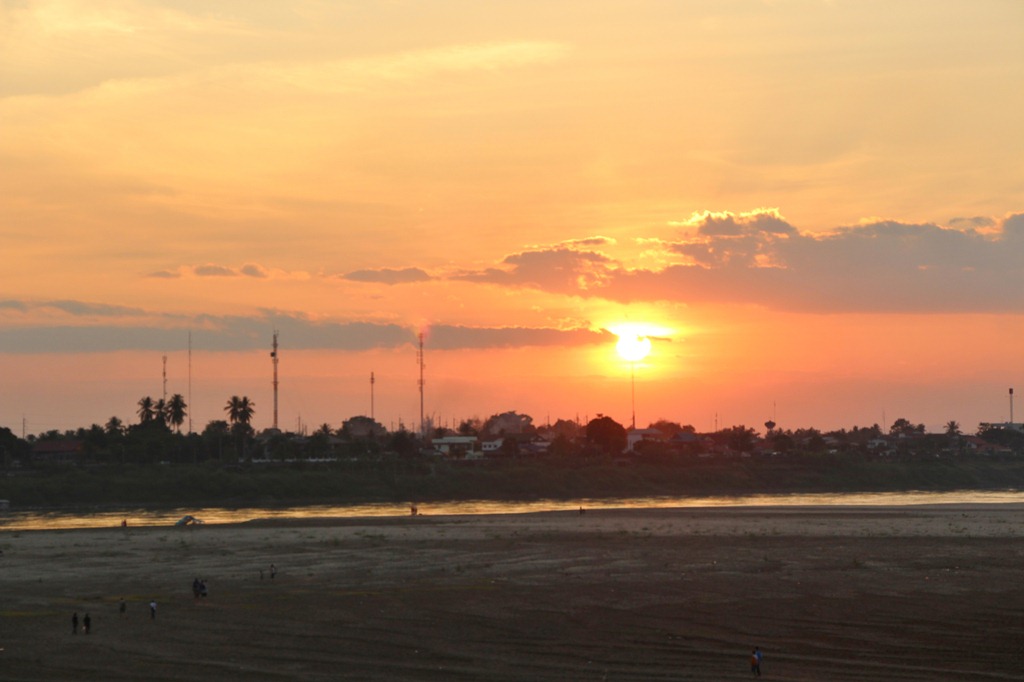
Sunset on the Mekong River in Vientiane

Sunset on the Mekong River in Vientiane

Sabaidee – hello. Everyone greets me and I greet them in return. Always a smile. Happy when I greet them first.

Say “Mekong River” and I immediately think of the war in Vietnam and all the horrors that went with it. But sunset on the river was innocent.

Vientiane is the capital of Laos. We wandered in the heat past tangled wires, markets, and a school. A half-day tour took us to ancient temples.

Sunrise from our hotel in Phonesavanh

Sunrise from our hotel in Phonesavanh

Roosters woke us in Phonesavanh before dawn. Barking dogs soon joined the chorus. Fog blanketed the hill and we wore our fleeces to protect against the chilly air. I sat on our balcony and watched as the sun burnt the fog and warmed my stiff fingers. First the cell towers then the red tile roofs peeked through the mist until finally the whole valley was visible and only the faraway hills were concealed by fog.

We visited a farm where they teach village women to raise the mulberry plants to feed the silk worms and then to spin and weave silk.

I wonder how a people so badly damaged by my country could be so welcoming. And yet everyone I met in Laos had only a smile for us. The movie we saw in Phonesavanh about the “secret war” – the bombings in Laos left me numb with sorrow, outrage, and shame. We saw landscaping and tools made of the metal left over from the bombs dropped on the countryside.

The Plain of Jars has thousands of ancient jars strewn across the landscape. No one is certain what they were used for. This area was heavily bombed during the war. It saw a lot of fighting as the communists used the jars and nearby caves for protection. Note the bullet hold in the jar. We had to walk carefully along the marked paths – for bombs still litter the countryside.

Laos is one of the poorest countries in the world. Plagued by ordnance that explodes as new fields are sown, villagers still work new fields to feed a growing population, losing limbs and children and cows. And while the country is poor, I did not see starving children, beggars in the streets, homes of cardboard and corrugated metal. Everywhere was clean –the streets unlittered not pock-marked with plastic bags and bottles and trash indifferently dropped as you see in India or some places in Mexico. The markets don’t smell. We drove from Phonsavanh to Luang Prabang, passing through Hmong and Khamou villages.

Luang Prabang is nestled between the Mekong and Khan Rivers. A twenty-mile bike ride through small villages, on dusty roads took us along the river to Pak Ou Caves – ancient caves filled with thousands if Buddha images from very tiny to larger than life size. We piled ourselves and our bikes onto a boat back to the city. The water level was low, exposing tree roots. Locals take advantage of the rich soil, planting crops along the river.

We took an elephant ride into the teak forest near the Khan River and then trekked back. The elephants are domesticated, raised to harvest teak. As the forests have been cut down, there is little work for them any more. Here they have been put to work giving rides to tourists. We checked carefully to see that they were well cared for. The ride in was pleasant – we were amused to see signs naming the trees at “top-of-elephant” level. We ate in the jungle by a beautiful stream, walked back to the Tad Se Waterfall. The water was freezing but welcome after the hot walk.

Up before dawn, we watched the parade of monks going for morning alms. It was the only time we saw this in Laos – though we saw over and over in Burma.

A city tour took us to many temples and to see the sunset at Mt. Phousi. The novice monk is repainting the temple but I was amused to see the earbud.

Food at the night markt in Luang Prabang

Food at the night markt in Luang Prabang

The night market as Luang Prabang had its own energy. All the crafts – scares and clothes, wooden trinkets, and…. – seemed shiny new and exciting, colorful and unseen by us before. A small side street housed food vendors selling skewered meats and smorgasbords of salads, noodles, and rice.

The food markets are replete with fresh vegetables. The rural poor are poor. Dirt poor. But they do not starve. The chef at our hotel takes us to the market and tells us what the different foods are – greens and herbs mostly. But he introduced us also to dried mushroom chips – think potato or banana chips – dried with lime and chilies.Then we took a cooking class!