
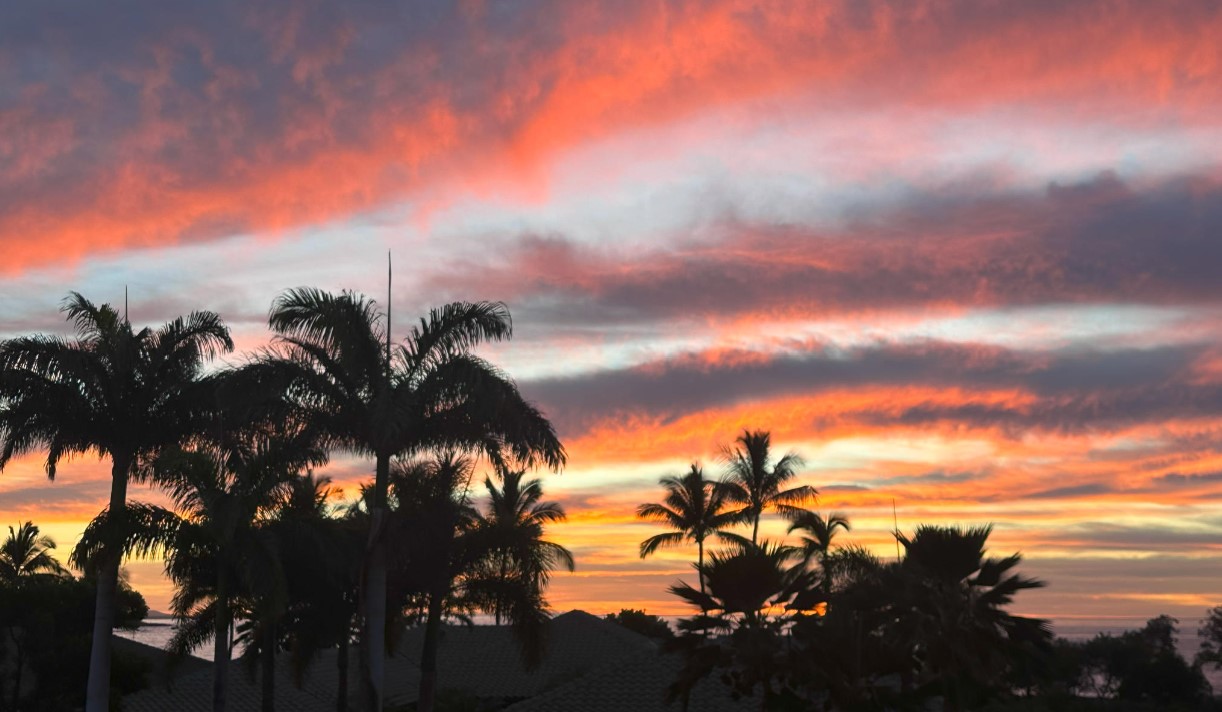
Putting politics aside, 2024 was a momentous year for both of us. We started the year staying at our place on the Big Island of Hawaii as we’ve done for the past three years. Work starts for me long before sunrise. Janet stays on a less early but still busy schedule. We entertained ourselves with visits from friends and family, bike rides, scuba diving, and amazing sunsets nearly every day. We ended the year in Hawaii as well, with me partially recovering from surgery for a partial retinal detachment from which I’m now recovering from a second less invasive surgery the second week of January, and for which I’ve included a public service announcement at the end of this blog. If you’re particularly nearsighted, please be sure to read it.

I’m 25% Swedish but had never been to Sweden even for business. Our good friend Janet M. is 50% Swedish and was in the same situation. In June, the two Janets, Janet M’s husband Tim, and I went to Copenhagen and then drove across Sweden. We visited our ancestral homelands where we enjoyed both the countryside and Stockholm, and completed our trip in Kiruna, the Northern-most inhabited Swedish city, inside the Artic Circle.

In October, we joined friends in Kolkata (formerly Calcutta) India for about a week to experience an annual event called Durga Puja, during which the goddess Durga’s victory over evil is celebrated. Even our Indian friends pointed out “…it’s really crowded…”, which says something. Millions attend, similar but likely larger to the numbers for Carnival in Rio. The crowds were not as bad as we were warned, and it was visually stunning along with great cultural immersion, learning, and wonderful Bengali food. More here.

Fulfilling Work for Both of Us
While we did have two nice vacations this year, Janet and I both worked as hard as ever, enjoying most of it as usual. Janet finished her time on the Seattle Foundation board, ramped up her engagement with the Womens Donor Network, and helped the reproductive rights nonprofit she co-founded get into high gear. All of the younger generation are doing well, with William still using big data and AI to help find the fountain of youth at Altos Labs, Sarah with a thriving therapy practice as well as a thriving new office concept for therapists, The Reflective Collective, and Aabha happily working to bring healthcare and AI together at Commure.
I remain focused on venture capital investing in India and the Global South, with a team distributed around the world. There are now only four of us in USA, five spread from Mexico City to Sao Paulo, two in Nairobi, fifteen in Bangalore, and two in Jakarta. We had two big milestones this year – one very profitable sale of a gig enablement company in India, and a second similarly profitable partial sale of our stake in a payments company (that’s now a unicorn!) addressing the under-banked in Nigeria. It helps grow one’s VC business when you start chasing your investors to get their bank info to send them money. With three other companies preparing for IPOs in 2025, the year ahead will not be boring; planning and capacity building is the name of the game. I’ve also been writing quite a bit about VC and Generative AI in the Global South, with some interesting posts here and others here. And I am almost through the first draft of a book I’m co-authoring, titled “Flourishing with AI“. I’m always looking for interesting people to interview for the book – please send anyone my way you think would be interesting (target age 27 to 40).
A Public Service Announcement: Take Care of Your Eyes
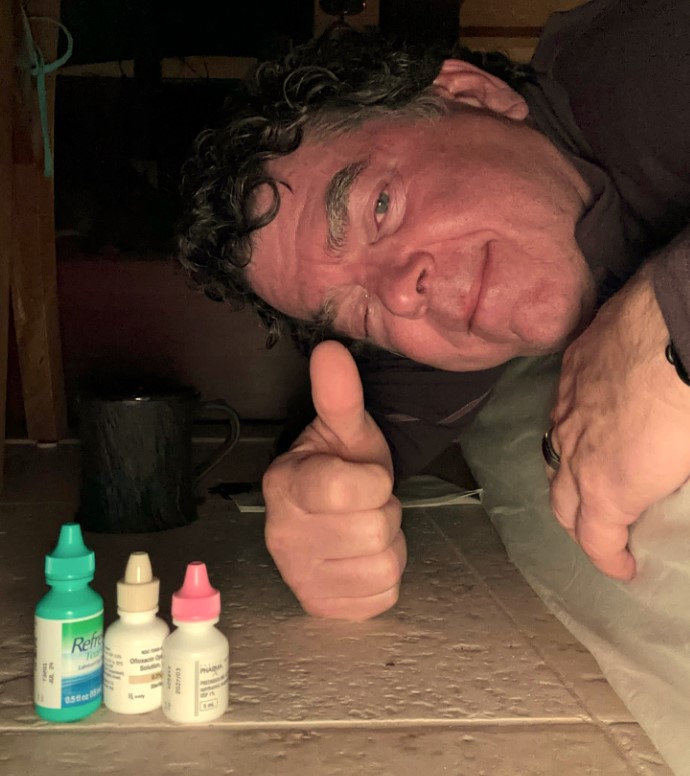
As alluded to above, I ended the year with a narrow miss in losing vision in my right eye, and as of week 1 January, I’m still not out of the woods, with a second less invasive surgical recovery in the process. I’ve known I’m at risk of retinal issues as they run in my family (my dad had a detachment when he was 30, and his mother and grandmother had issues as well). I’ve been religious about getting annual exams and watching for anything remotely out of the ordinary. To make a long story short, I had my third posterior vitreous detachment (“PVD”) in late October, which led to a partial retinal detachment likely at the same time, but not diagnosed by two different specialists until I saw a third the Tuesday before Thanksgiving (Nov 26th). The detachment was not caused by my mountain biking or anything I did other than being fathered by someone with similar issues that he inherited as well. Genetics are what they are; being acutely aware is usually all you can do. This is how I spent a week post-surgery, lying on my side or face down, 24×7, other than a few breaks a day. And how I’m doing it again after surgery #2. Ugh.
If you are very nearsighted (which you can determine by a negative number in your distance vision correction in your glasses or contacts being between -3.5 to -6) or extremely nearsighted (greater than -6), and/or you have a family history of retinal issues, please pay attention. Being over 50 is another contributing factor. If you’re farsighted or average nearsigned and have no family history, this situation is not likely to be a problem for you.
PVDs as the Beginning: PVDs are quite common in people over 50 who are modestly nearsighted. In their simplest form, they create a floater or two and nothing else. But they can be indicative of a potential for a future retinal tear, which is why you should learn the symptoms of a PVD, how to distinguish between a floater and a sign of a retinal tear, and to in all cases ensure you see a good retinal doctor as immediately as possible if you notice a PVD.
Your Eyes and Detachments
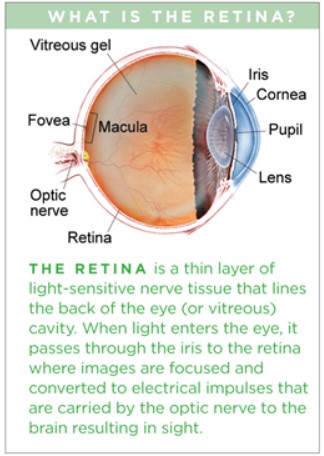
Vitreous Humor: This is a gel-like substance that fills the eye, primarily composed of water and collagen. At birth, it has a gel state due to a network of fine collagen fibrils. With age, the collagen fibrils aggregate and the vitreous becomes more liquid, leading to a condition known as vitreous liquefaction. This process typically begins around age four and continues throughout life.
Vitreous Detachment: As the vitreous shrinks and liquefies, it may pull away from the retina, a phenomenon referred to as posterior vitreous detachment (PVD). This usually occurs after age 50, with increased risk as one ages. During PVD, the vitreous can exert tearing pressure on the retina due to its attachment at certain points. This can lead to complications such as retinal tears or detachment.
Symptoms: Common symptoms of vitreous detachment include an increase in floaters (small dark spots in vision) and flashes of light in your peripheral vision. These occur when strands of the vitreous cast shadows on the retina and/or tug on it. You need to get them checked, but chances are you are OK. The things to be really focused on are symptoms of retinal detachment. They include bright flashes of light, especially in peripheral vision, blurred vision, new floaters in the eye that appear suddenly, and/or what happened in my case, shadowing or decreased peripheral vision that seems like a curtain or shade across your vision. The latter is a big deal – don’t let anyone try to convince you that it’s “just a big floater” which is what happened to me.
Treatment Speed: Time is of the essence once your retina starts to tear or detach.
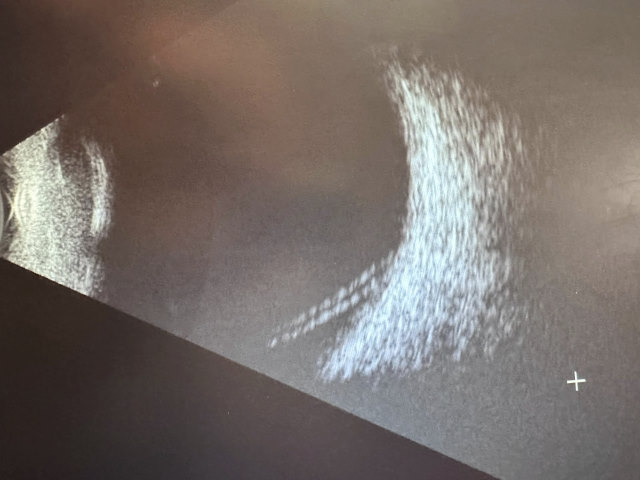
I know two people who had partial detachments and were not able to able to treat them as quickly as they should have. One has regained full vision, the other never will. Fortunately, I noticed the symptoms, went to specialists three times, and during the third visit, Doctor Eugene Ng (to whom I’m most grateful) said “uh-oh”. This is not something you want to hear. We did the ultrasound and saw it was clearly torn. The two lines at the bottom of this ultrasound image are my retina pulling off the back of my eye. I went for emergency surgery later that day. That entailed flying from the Big Island of Hawaii to Oahu which is about a 30 minute flight away, where they have a hospital with appropriate specialized equipment and trained nurses to support the surgeon. We came back the next day and I then spent the following week working from my phone lying face down and/or lying on my side looking at the palm trees and listening to podcasts. Thankfully I had Janet and other family members around to help out. And then 4 weeks later, going in for a routine post-op checkup, we found some anomalies, went to a specialist who did the deep imaging, and found that I have yet another partial detachment in evidence. Hence surgery #2 which is a little different and hopefully will be a once-and-for-all fix. Dr. Eng used a series of laser zaps. Imagine looking into a bright light and the doc looking through a special lens to see the places to fix and he pulls the trigger and a laser cooks a little bit of your eye to make the scar tissue hold it all together. I’ve done this twice now, which hopefully is all that’s needed. I will not know that for another month or two, but everyone is fairly confident that this will work.
Summary
When I had my first PVD 2.5 years ago, it freaked me out and I went to see a specialist immediately. They confirmed it was not a problem, and they said I was likely to have one in the other eye within a year. That indeed happened about a year later, and I took it in stride, going to see a specialist a few weeks after, as I was a bit of an expert at that point. It was the third time, about 9 months later, that the symptoms were different. Thankfully I jumped on it and monitored closely, ultimately getting surgeries not too long after the tears kicked in, and I’m confident I’ll have a full recovery. Recommendation to my readers: if you have any of the correlated risks noted above, dive in and learn more, do not doubt yourself when you see things that do not seem right, don’t take chances, and be prepared to do whatever it takes to get it fixed quickly if this happens to you.
Will
 Poolinger Family Site